In the future, powerful LASERs will make missiles worthless and nukes will be used only to finish off an already crashed enemy, but even a LASER cannot stop an incoming plasma strike. So plasma railguns will be developed in the future along with LASERs as main weaponry. Both of these weapons have only one ammunition: Energy. If you have enough energy, you will never run out of ammunition...
Plasma railguns.
A plasma railgun is a linear accelerator which, like a projectile railgun, uses two long parallel electrodes to accelerate a "sliding short" armature. However, in a plasma railgun, the armature and ejected projectile consists of plasma, or hot, ionized, gas-like particles, instead of a solid slug of material. Scientific plasma railguns are typically operated in vacuum and not at air pressure. They are of value because they produce muzzle velocities of up to several hundreds of kilometers per second. Because of this, these devices have applications in magnetic confinement fusion (MCF), magneto-inertial fusion (MIF), High Energy Density Physics research (HEDP), laboratory astrophysics, and as a plasma propulsion engine for spacecraft. Plasma railguns appear in two principle topologies, linear and coaxial. Linear railguns consist of two flat plate electrodes separated by insulating spacers and accelerate sheet armatures. Coaxial railguns accelerate toroidal plasma armatures using a hollow outer conductor and a central, concentric, inner conductor.

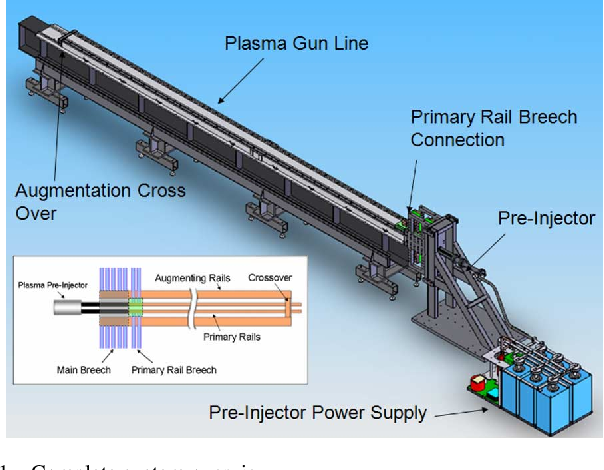

Normal railguns.
Electromagnetic railguns and lasers are two technologies the military is harnessing as an alternative to gunpowder. The U.S. Navy is pioneering the futuristic weapons that could play a vital role in future combat.
General Atomics Electromagnetic Systems announced Wednesday that its Blitzer railgun hypersonic projectiles successfully passed tests at the U.S. Army Dugway Proving Ground in Utah between 7 and 9 March 2016. Both General Atomics and BAE Systems have created cutting-edge Electromagnetic Railguns. In 2012, the Office of Naval Research began testing them.
A railgun projectile will travel at Mach 6 – that’s nearly three times faster than the typical bullet. And the railguns will be able to strike threats more than 100 nautical miles away in approximately six minutes. They could be deployed against a range of threats for precision strikes against land, water surface or air targets.

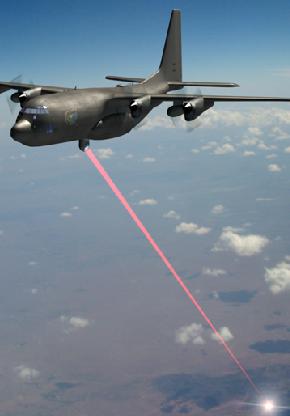
Solid State Fibre Laser Guns.

-15)_in_November_2014_(05).JPG/300px-Laser_Weapon_System_aboard_USS_Ponce_(AFSB(I)-15)_in_November_2014_(05).JPG)


Δεν υπάρχουν σχόλια:
Δημοσίευση σχολίου
Σημείωση: Μόνο ένα μέλος αυτού του ιστολογίου μπορεί να αναρτήσει σχόλιο.